




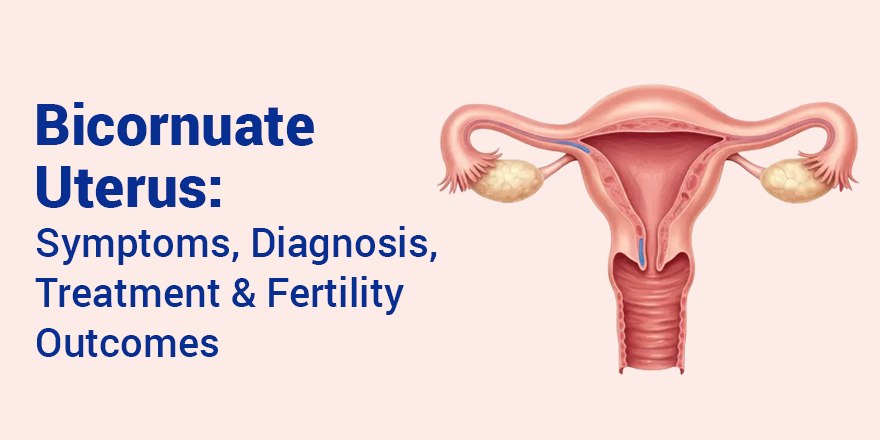
Bicornuate Uterus: Symptoms, Diagnosis, Treatment & Fertility Outcomes

If you have a bicornuate uterus, that means your uterus is heart-shaped. The uterus is the organ in a woman’s body that holds a baby. This condition is sometimes referred to as a heart-shaped womb, as it actually looks like a heart. The shape of your uterus is crucial if you have become pregnant, as it affects how the baby lies with a defect in the shape, size, or structure of the uterus. A bicornuate uterus is one of the common types of uterine irregularities. In this blog, we will find out more about a heart-shaped uterus and what the symptoms and causes are behind it.
What is a Bicornuate Uterus?
A bicornuate uterus, commonly referred to as a heart-shaped uterus, occurs when the upper part of the uterus, namely the uterine horns, forms as a two-horned structure despite having a single united uterine cavity. Think of it as an imaginary division of the uterus into two equal parts that creates an indentation or depression at its top end. This is not a condition that appears suddenly; rather, it is a congenital Mullerian anomaly, meaning a person is born with it. The development of such a uterine anomaly takes place in the prenatal stage because of the partial development of the ducts of the uterus.
Causes of Heart-Shaped Uterus Pregnancy
When looking for the causes of a bicornuate uterus, the only thing we can say about them is that we don't know the exact cause for anyone in particular. As we already mentioned above, a bicornuate uterus is a congenital Mullerian anomaly that means this kind of uterus develops when a female baby is still developing in its mother's womb. While two structures called the Müllerian ducts should properly develop into a uterus during development, the most reliable answer is again "we don't know the exact cause for anyone".
When it comes to the causes of a bicornuate uterus, the simplest answer is: we don’t know the exact reason for any individual.
Since a bicornuate uterus is a congenital Müllerian anomaly, it means the condition develops while a female baby is growing inside her mother’s womb. During this early developmental stage, two structures, known as the Müllerian ducts, are supposed to fuse completely to form one single uterus. In the case of a bicornuate uterus meaning, this fusion is only partial, leaving the uterus divided.
There is absolutely no clue as to why it occurs to some and not to others. It is not caused by anything you did or didn’t do, nor is it linked to lifestyle, diet, or environmental factors. It is simply a developmental difference.
What are the signs of a heart-shaped uterus?
A heart-shaped uterus does not present with symptoms at all, especially before pregnancy occurs. This is because of the absence of symptoms; women who have a heart-shaped uterus would never come across such a condition until they undergo ultrasonography. But still, there are certain symptoms for women having a bicornuate uterus, such as:
How can a heart-shaped uterus be diagnosed?
Of course, if you experience any of those symptoms listed above, then you should see your health care provider. Some of the examinations done by doctors include:
Physical examination of the woman's pelvic area
Heart-shaped uterus ultrasound, which is also known as Hysterosalpingogram, is the X-ray of the womb and the fallopian tubes filled with dye fluid
Ultrasound examination, where high-frequency sounds make images of the uterus.
Does a heart-shaped uterus influence your fertility?
According to most medical professionals, while some other problems with the uterus may be linked to fertility issues, the heart-shaped uterus will not normally have any negative effect on your ability to get pregnant or have the fetus implanted in the lining of the uterus. In other words, in terms of conception, you will face no problems, yet complications arise during pregnancy.
Pregnancy and a heart-shaped uterus
The ability to get pregnant will not be influenced by the heart-shaped uterus. Nevertheless, it poses some risks for a good pregnancy due to increased miscarriage rates. It is suggested that this is caused by decreased space within the uterus. Besides, abnormal contractions may occur.
Risk of miscarriage
It is unfortunate, but the risk of miscarriage cannot be determined easily in every individual case. As mentioned by a study by the UK’s Royal College of Obstetricians & Gynaecologists, the risk lies somewhere between 1.8% and 37.6%. The wide gap is caused by the fact that there are not many studies on the subject, and all of the few existing ones have involved women with one, two, or three miscarriages. They do not make any statistical distinction between early miscarriage and late miscarriage. One observation made from the study, however, is that the latter seems to be more prevalent among women with a heart-shaped uterus. That could also be caused by their weak cervix.
Cervical insufficiency
Weakness in the cervix is another symptom commonly observed among women with a heart-shaped uterus. The cervix is the lowest part of the uterus that opens into the vagina, and in healthy women, it remains closed throughout pregnancy until it begins to soften and open up as preparation for delivery. However, in the case of cervical insufficiency, the cervix becomes soft before it should, resulting in miscarriage or premature birth.
Greater probability of Cesarean Section
In addition to the above risks, a heart-shaped uterus increases the probability that your baby might be in the breech position. In such a situation, the baby is in an inverted position; i.e., his/her head is at the top, with the bottom directed downward toward the cervix during delivery. As such, doctors watching your pregnancy may opt to suggest a cesarean section.
How can a heart-shaped uterus be cured?
As already pointed out earlier, a heart-shaped uterus can bring complications for a pregnancy. Here are some of the measures that are often taken when you have a heart-shaped uterus and are expecting a baby.
Surgery
Surgery is not the preferred treatment for cases of a bicornuate uterus. If, however, surgery becomes necessary for patients who suffer recurrent abortions due to this condition, then a Strassman metroplasty can be done with a success rate of 88%.
Arcuate Uterus Treatment
The treatment for an arcuate uterus relies on the individual’s symptoms and reproductive goals. However, some of the options may include:
Medications: Hormonal treatments may be prescribed to manage menstrual irregularities or other symptoms.
Monitoring: If a woman is asymptomatic and has no reproductive issues, regular monitoring might be sufficient.
Surgical Options: Surgery might be suggested for women experiencing significant reproductive difficulties. However, surgical options include:
Hysteroscopic Surgery: This minimally invasive method can be used to remove any septum or abnormal tissue within the uterus.
Uterine Reconstruction: Surgical procedures can be performed to reshape the uterus, although it is not always necessary or effective.
Also Read: PCOS Infertility: Causes, Impact, and Effective Treatment Options
Non-Pharmacological Treatments
In addition to the surgical and medical treatments, lifestyle modifications can support reproductive health:
Regular Workout: Engaging in regular physical activity will help maintain a healthy weight and improve reproductive health.
Stress Management: Techniques like Yoga, meditation, and counselling will help in handling stress that will affect fertility.
Healthy Diet: A balanced diet rich in fruits, vegetables, whole grains, and lean proteins can promote overall health.
Special Considerations
Different populations may require tailored approaches to treatment:
Final Thought
Being told you have a bicornuate uterus pregnancy can be confusing, especially if you are trying to conceive or are already pregnant. Simply put, it is a mild variation in the shape of the uterus with a slight dip at the top. This mild uterine anomalyis often discovered incidentally in the fertility evaluations or pregnancy scans. But what does it mean for your reproductive health? Let’s break it down with reassurance and clarity. Furthermore, if you are looking for the Fertility Clinic Near Me, then Seeds of Innocens IVF, which is one of the Best IVF centres in Delhi, is right around the corner to guide you and provide you with the right treatment.
Also Read: Uterus Infection: Causes, Symptoms, Treatment, and Prevention
Frequently Asked Questions
1. Is a bicornuate uterus genetic?
A bicornuate uterus is a congenital anomaly that is present at birth and is generally not considered a strongly hereditary or genetic condition that is passed down in families.
2. Can a bicornuate uterus cause infertility?
Yes, it can sometimes lead to infertility, preterm birth, or recurrent miscarriages.
3. Do all bicornuate uterus need surgery?
No, Surgery is only required if there are repeated pregnancy losses or both cavities are small.
4. Is a bicornuate uterus dangerous?
It is not dangerous for general health, but can affect reproductive outcomes.
5. How is a bicornuate uterus different from a septate uterus?
A bicornuate uterus has two cavities with a divided fundus, while a septate uterus has one fundus with a septum inside.